A Family Biography
By
ARNOLD GUEBERT
EDMONTON, ALBERTA,
CANADA
1936
Click the link to view or download the scanned document: Scanned pdf
Note: The PDF will open in a new window.
INTRODUCTORY
The chief purpose of this brief biography is to preserve some of the interesting facts in the history of our family, particularly the history of the earlier years. Experience has shown that within a comparatively short time children and children's children forget who their forefathers were or where they came from, to say nothing of the interesting events of their lives; and yet all relatives like to know something about those who are of their own kin if only the material can be made available. For this reason the writer has taken it upon himself to publish this little volume. He has always been particularly fond of digging up historical material and was fortunate enough to find some old letters and deeds which, he feels sure, will make this account of real value.
We have also endeavored to record the names of all, living or dead, who have been or still are Gueberts. We believe we have succeeded in this. We did not mention the names of all the children and children's children of the girls. We felt it would have taken too long to get all this extra data and would have made the undertaking too expensive. In the case of the girls we have usually been content with recording the name, occupation, and place of residence of the husband. Data and the most important facts in the life of each relative were included wherever available. We beg the indulgence of anyone who may find that something important has been omitted. He may be sure that it was not done intentionally.
It was difficult to find suitable pictures of the pioneers. Back in 1850 there were no cameras and having your picture "took" was quite an event. Thus it happens that not one single picture of Mrs. Christ Guebert (I) could be found. Grandpa William Guebert (I) was also averse to having his picture taken at any time. The one we have of him was snapped by a visiting student while Grandpa was sitting in his armchair. It was taken without his knowledge or consent.
We should also like to state here that we have received excellent co-operation from the relatives in the preparation of this volume. Not one personal letter we have written has remained unanswered. In one case a letter traveled from Illinois to Texas and back to St. Louis, Mo. before it was answered. We wish to thank all those very heartily who have responded so wholeheartedly to our requests for information and thus helped to make this biography more complete.
December 31, 1936.
ARNOLD GUEBERT.
CHAPTER I.
THE ORIGINAL HOME
The home of the Gueberts in the old country was the village of Schierin-Eigen, near Bueckeburg, in the principality (Fuerstentum) Schaumburg-Lippe (population 42,000), Germany. The name Schaumburg-Lippe no longer appears on most German maps. It was one of the small principalities of which there were hundreds in Germany even 125 years ago. It lay just west of the city of Hannover; and Bueckeburg, which still can be found on any good map, was its principal city. Thus the Gueberts were originally Hanoverians and spoke that Low German dialect. High German was spoken only on occasion, though, of course, it was used exclusively when writing.
Whether there are still Gueberts in Germany to-day we do not know. It seems this family was the only one of that name in and around Bueckeburg. No letters from any Guebert across the water have ever been found. We have a few written by a William Kemker, who was a cousin and lived in Meimsen, Germany. Mathilde Guebert, youngest daughter of the pioneer Christian (I), made a trip to Germany in 1912 and stopped off at the home place. She writes as follows: "I was in Schaumburg-Lippe in the year 1912; but I am very sorry to say that I did not find any Gueberts there. I was on the farm where my grandparents lived, but there were no buildings left on the place, only a little corner of rocks, left from the bakeoven. Some other people bought the land. My uncle Kroemer from my mother's side told me that was the only family there by the name of Guebert. There were Ahnefelds, Eggerdings, Davids, and Lohmanns. I surely did enjoy it there. All the buildings on the home place of my mother's folks were still there. My uncle Kroemer passed away several years ago."
We agree that it must have been a thrill to stand on the ground once trod by the feet of the forefathers. Incidentally, Mathilde was the first of the Gueberts to make a trip to the old country; in fact, she and her niece Martha, daughter of Henry W., are the only members of the family who have had that privilege. None of the old timers ever went back for a visit to their former home.
We have often wondered what the name "Guebert" really means or from what word it is derived. For the benefit of the later generations we might add here that in German the name would be spelled "Glübert". In other words the "ü" would be umlauted. However, there is no word in the German dictionary which begins with güb. There is the foreign word "Gubernator" which is derived from the Latin and means "helmsman" or "governor"; but we are not ready to advance that as a solution to the problem. Our cousin Beatrice, wife of Prof. H. Grunau of Bronxville, New York, avers that the name might originally have been "Gülbert" and had a French origin. Our own guess is that it is derived from Geber, Geburt, or possibly Grueber. But it's any man's guess thus far. Some day when we make that proposed trip to the old country we shall look into this matter and see whether we cannot trace the origin of this rather unusual name.
CHAPTER II.
THE IMMIGRANTS
The history of the family in America begins with the immigration of William Guebert (I) and his brother Henry in the year 1850. William was born in 1830 and was, therefore, 20 years old when he came to America. His brother was 17. Just what made these young Germans leave home and country we do not know, but it was undoubtedly the call of America at that time. America was the "Land of Opportunity" to many thousands of Europeans. We must remember also that 1848 was the year of revolutions in Europe; and the strife and unrest caused many to leave that overcrowded and harassed continent and seek their fortune and found a new home in this favored land. Then, too, friends of the Gueberts, the Schriebers, Eggerdings, and others, had settled in Horse Prairie before 1850, and no doubt wrote to their acquaintances in the old country urging them to emigrate. At any rate, the two brothers, together with the Carl Nagel family and perhaps others, started out in the year mentioned. They left behind: their parents, a brother, Christian, and a sister, Sophie.
The journey across the ocean lasted nine weeks. This seems an extremely long time to us, but we must not forget that the ships in those days were very small and did not average even 5 miles an hour. They were often buffeted about by the storms for days and the accommodations, particularly for immigrants, were anything but good. An ocean voyage was by no means a pleasure in 1850. These facts will explain, to a measure at least, why very few of the old timers longed to make another trip across the ocean.
The ship of our two immigrants landed at New Orleans. It seems this city was the favorite port of entry for those settling in what was then the West. From New Orleans the newcomers made their way up the Mississippi just as the Saxon immigrants, who founded the Lutheran Missouri Synod, had done eleven years before. They left the boat at St. Louis, Mo., and William, Henry, and Mr. Carl Nagel crossed the river in a ferry and walked the forty miles to Red Bud. They did not have $5.00 between them, all their money having been used for traveling expenses.
We might add here that Red Bud was at that time a mere hamlet. It received its name because there was a large thicket of grape vines and red bud trees where the creamery, or rather ice plant, now stands. Red Bud was organized as a village in 1866 (after the Civil War) and did not have a railroad until 1875. There are still people living in Red Bud who remember that produce had to be hauled all the way to St. Louis or Belleville by team and wagon.
Arriving in Red Bud, the new immigrants looked up their friends in Horse Prairie. After they had secured a team and wagon they drove back to St. Louis in order to get their belongings and the rest of the party. Among the members of this group was little Engel Nagel, then nine years old, who seven years later became the wife of William Guebert. The Carl Nagel mentioned here was the father of old Uncle Fred Nagel, who formerly lived east of Red Bud and will be remembered by some of my readers.
Our two young German immigrants soon found work on the farm, Henry for an Anton Busse, who lived east of Red Bud, and William for Carl Schrieber in Horse Prairie. William could not have stayed at Schriebers very long for in the same year we find him in the employ of Henry McSimmons. The McSimmons farm lay at the southeastern edge of what is now Red Bud. It included 240 acres and constituted the larger part of the Chas. F. Guebert and the Henry W. Guebert estates, at present occupied by Alfred F. Guebert and Herbert Guebert, respectively. The farm extended north to what is now East Market Street. One of the main thoroughfares ran along the west side of this farm, directly south of the present Public School. The house on this farm stood just east of the present rock house, occupied by Herbert Guebert and his mother, Mrs. Henry W. Guebert. Some of my readers will remember a wind-mill and well about 300 yards east of the present home. That is where the original house stood.
Young William worked for McSimmons for about five years. At this time, towards the end of 1854, McSimmons was tired of farming and wanted to sell out. Since everything had been taken out of the land and nothing put back in we can guess the reason. He accordingly offered to sell the farm to his trusted hired hand. William, however, was loaded to buy for he had earned probably $150-$200 a year. He, therefore, said to his employer: "I cannot buy this land. I have no money". "You don't need any money," said Mr. McSimmons. "If you want the farm I'll sell it to you without money". Surely the hired man had gained the respect and confidence of his employer. Mr. McSimmons undoubtedly meant that he would be willing to wait for his money, knowing full well that he would get it. The price asked was $5,000.00.
William, however, did not like to load himself down with such an enormous debt. He accordingly wrote his brother Christian in Germany asking him to join him in buying the 240 acre farm. It is entirely possible that Christian and the rest of the family intended coming to America anyway. Christian agreed to William's proposition, and so these two brothers purchased the farm, which has remained in the hands of the Gueberts ever since. We have been fortunate enough to secure the original deed which has been well preserved and now lies in a safety deposit box in the First State Bank of Red Bud, Ill. We believe this will interest everyone and, therefore, insert a complete copy in the following chapter.
CHAPTER III.
SOME INTERESTING DEEDS
The original deed of the Christian and William Guebert farms reads thus:
"This Indenture made and entered into this 4th day of January in the Year of our Lord One thousand Eight hundred and fifty five Between Henry McSimmon and Mary his wife of the first part of the County of Randolph and State of Illinois and Frederick Christian Giebert and Wm. Frederick Gubert of the County and State afforesaid of the second part Witnesseth that the said Henry McSimmons and Mary his wife for and in consideration of the sum of Forty Hundred Dollars to them in hand paid by the said Frederick Christian (Gierbert) and William Frederick Gubert the receipt whereof is hereby acknowledged has Granted Bargained and Sold and by these presents do hereby bargain sell convey and confirm unto the said Frederick Christian (Gierbert) and William Frederick Gubert and to their heirs and assigns forever and the said Henry McSimmons and Mary his Wife the aforesaid premises unto the said Frederick Christian (Gurbert) and William Frederick Gubert their heirs and assigns forever against the claim or claims of all and every person lawfully claiming the Same do and will Warrant and forever defend by these presents.
In Witness whereof the said Henry McSimmons and Mary his wife of the first part has hereunto set their Hands and seal the day and year above written
(Signed) Henry Mc Simmons (Seal)
her
Mary X Simmons (Seal)
mark
Signed Sealed and delivered
in presence of us
W. D. Simpson.
State of Illinois
Randolph County
I the undersigned a Justice of the peace within and for said
Do hereby certify that Henry McSimmons and Mary his wife whose signatures appears to the foregoing deed of conveyance and who are personally known to me to be the identical persons whose names are subscribed to the said deed as having executed the same this day appeared before me and acknowledged that they had signed sealed and delivered the same as their free act and deed for the uses and purposes therein expressed and Mary Simmons wife of the said Henry McSimmons having been by me made acquainted with the contents of said deed and been by me examined separate and apart from her said husband acknowledged that she had executed the same and relinquished her right of dower in and to the premises freely and without any compulsion of her said husband.
The testimony whereof I have hereunto set my hand and seal this sixth day of January 1855.
(Signed) W. D. Simpson J. P."
CHAPTER IV.
THE FIRST THIRTY YEARS IN AMERICA
But now to get back to our story of the Guebert brothers. When Christian came across he brought along the rest of the
family, his parents and sister Sophie. This might have been in the latter part of the year 1854. At any rate they were here in the early part of 1855. The father's name was also Christian. (Note: The names Christian, William and Henry occur quite often. In order to avoid confusion we shall dub the three pioneer brothers William (I), Henry (I), and Christian (I), though this Christian was really the second of that name.) The father of the three brothers died Aug. 17, 1855 during the first year of his sojourn in America. He lies buried in the cemetery at Horse Prairie. We have found that many of his descendants do not even know that he came to America. His grave is in the north-east corner of the cemetery very near the teacher's residence, and the inscriptions are still plainly legible. He died in his 58th year having been born March 10, 1797. The old grandmother lived 20 years longer. She lies buried in the Lutheran cemetery at Red Bud. The inscription on the tombstone reads: Born Oct. 30, 1790; Died Dec. 3, 1875. Some of our readers may ask why our great grandparents are not buried in the same graveyard. The reason is simple: St. John's Lutheran Congregation in Red Bud was not organized until 1855 and did not own property until the following year, while Horse Prairie Congregation is much older, having been started already in 1840.
The two brothers, William (I) and Christian (I), divided the farm they had bought into two equal parts, William taking the north half and Christian the south half. This south half, as before stated, had the buildings. The old house was later moved to town just east of the present Herman Rathert residence and was long occupied by one Peter Best. The building has since burned down. The present rock house on this farm was built in 1864.
On William's lot there stood on the present site of the Alfred Guebert residence a log house, which was probably a settler's home before Illinois became a state. A new house and also the present barn were erected some time in the 60's. The house was later on enlarged and still later (1914) rebuilt by the writer's father, Chas. F. Guebert.
At this juncture we insert a letter found by the writer in a book originally belonging to his grandfather, William Guebert (I). The letter was written in 1881 and gives a resume of the outstanding events in the family's history during the first 30 years in America. Fortunately for us the letter was never mailed and we dare say the "good friend and comrade" never did hear from his old acquaintance in America. Translated into English the letter reads thus:
Dear Friend and Comrade:
I must first of all ask your pardon, for, to have been separated for 30 years and not to have exchanged one letter, is
certainly not a sign of good friendship. I was reminded of you through a letter of Mr. Klauen to F. Roesemeier, which contained a greeting from you to all acquaintances. I immediately resolved to write you in order to make good what I have neglected. Now, I would like to have you write and tell me how your sisters and their husbands and your brother Carl are getting along, if they are still alive, and also your own family. According to reports both your eldest sons are in the army. I have also heard, that your parents have entered their eternal rest long ago.
With regard to our family, no doubt you have heard that my father died in the first year, my mother on the other hand, only 3 (?) years ago. She reached the age of 76. My wife is the daughter of Carl Nagel. The Lord has thus far blessed us with 11 children, four of which He has already taken unto Himself, and seven of which are still living. The eldest, a boy, is 19. My brother Christian has 13 children, 12 of whom are still alive, and 2 already married.
With regard to my brother Henry, I might say that the Lord has laid a heavy cross upon him, in that he lost a leg in a threshing machine accident five years ago and must now wear a wooden leg. A year later a similar accident happened to one of his little boys, who, however, was killed instantly, and last summer he lost his wife also.
My sister Sophie and also her husband, E. Schoenbeck, died during the same year, 18 years ago.
As for myself, I live in a little town, and a good part of my land (is within the city limits). Red bud has 1700 inhabitants, and this summer much building is again going on. Since 6 years ago we have a railroad. Ten years ago we built a Lutheran Church, which cost $12,000.00 and which cost me $2,000.00. Last summer we also built a school house, which 16,00.--and I live only 200 paces from it.
With regard to my own circumstances, I can say that the Lord has blessed me more than too much, for I own almost 700 acres of land, some of which is worth $200.00 an acre. I am also a shareholder in a bank which is doing good business. I have an interest in a large mill and other things. Also my brothers are well off. Most of my land I have rented, and of this I get one-third without much work or trouble. I farm about 100 acres myself, since I have many side interests and much business in court. Last fall I was also a candidate for county "judge", but since I was on the Democratic side and since this party lost out in the entire country, I met the same fate. Who knows what it is good for!
The last two years we have had very good crops. Wheat costs $1.00 a bushel at the present time. This winter we have had very cold weather and it is still very cold.
I have heard that the poor people over there are having
very hard times. I do wish some of them were here, for I have plenty of land and other things, so that I could let them earn their daily bread. In case there are some who should like to come here and start farming, I would gladly help them. I could also find ways and means if they would not have the money for the trip. Also, if your grown-up sons would care to come, they could make their fortune here.
At the present time land costs between 50 and 60 dollars an acre, that is, a well equipped farm; of course, farther west the land is much cheaper. A good horse costs from 100 to 150 dollars, and a cow from 30 to 50. A hired hand earns from 15 to 18 dollars a month, and a girl 6 to 10.
I should also like to ask you to greet William Kemker of Meimsen if you have the opportunity, or let him read this letter, and ask him to write me and if I have time I will also write to him. Many greetings to all who know and remember me.
Hoping that you will not feel offended that I am writing you will fulfill my wish and answer at once, I remain,
Your old comrade,
WILLIAM GUEBERT.
Family Portraits
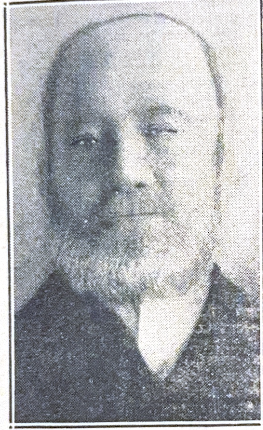
WILLIAM GUEBERT (I)
(March 1, 1830-Jan. 11, 1903)
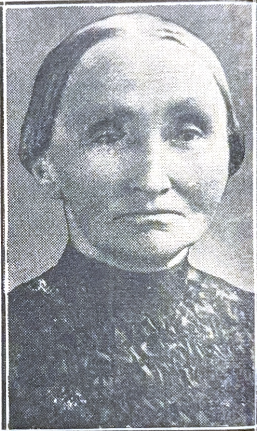
ENGEL GUEBERT, nee Nagel
(Sept. 13, 1841-Feb. 12, 1922)
CHAPTER V.
WILLIAM GUEBERT (I)
William Guebert (I) lived on the old homestead until his son Charles was married in 1891. He then removed to the property adjoining the home place, now occupied by August Voges and the Valentine brothers and owned by Edward Guebert. This place was originally owned by the Huegli family who had a large brick kiln where the tall barn now stands. The clay for the brick was gotten from fields due south and the excavations can be seen to this day. William lived on this place until his death in 1903. He reached the age of 73. His wife, Engel, lived until 1922. She spent the last years of her life with her son Charles, and was 80 years old at the time of her death.
The following is a list of the children of William (I) and Engel Guebert:
Karolina, 1858-1859
Christina, 1859-1872
William, 1861-
Frederick, 1863-1873
Karolina, 1867-1867
Charles, Mar. 7, 1868-Mar. 28, 1935.
Henry, 1870-1898
Herman, March 28, 1872-
Frederick, July 1, 1874-1918
Sophie, Nov. 18, 1876-
Martin, Feb. 8, 1879-
John, April 18, 1881-
Edward, June 4, 1883-
The reader will note that eight boys but only one girl grew to maturity. It must have been quite a blow for Grandma Guebert to lose her first three girls, one of whom was already 13 years old. A comparison of this list with the lists on pages 31 and 39 will reveal that the very same names appear again and again among the children of William's (I) brothers. Thus there were among the children of the three pioneers, 3 Henrys, 3 Fredericks, 2 Sophias, 2 Karolinas, 2 Christians, 2 Hermans, 2 Johns, 2 Marys, 2 Christians, and 2 Augusts. It seems rather queer to us that the brothers should have named their children alike, but it was the good old German custom. Oddly enough there was little confusion on account of this as no two of the boys, who grew up and were named alike, stayed around Red Bud.
William, eldest son of William (I), married Lydia Rahn in November 1885. He first lived on a farm in Ames. Later he moved to the present John Faust place east of Red Bud, then to the Schumacher place, west of the city, and then to the Peltzer farm. He now resides in Red Bud. He is 75 years of age and the oldest of the Gueberts now living.
Rev. Henry Guebert, fourth son of William (I), studied at Milwaukee, Ft. Wayne, and St. Louis, and entered the ministry in 1893. His first and only charge was at Stuttgart, Ark. Henry was one of the healthiest and most agile of all the boys. We are told that ofttimes he would not bother to go through a gate, jumping over the fence instead. Yet God in His all-wise counsel saw fit to call him home after but a few years of successful service in the ministry when he was in the prime of life.
Rev. Herman Guebert, fifth son of William (I), likewise studied at Milwaukee, Ft. Wayne, and St. Louis. He entered the ministry in 1904, his first charge being Kurreville, Mo. From 1895 to 1901 he was pastor at Baldwin, Ill. In 1901 he accepted a call to the congregation in Hinsdale, Ill., where he served until 1922. He now lives in Oak Park, Ill. and is assistant at the large St. Luke's congregation in Chicago (Pastor A. R. Kretzmann).
Rev. Martin Guebert attended college and seminary at Milwaukee and St. Louis respectively and graduated in 1902. His first charge was at Lawrence, Nebr. (1902-1903). On account of ill health he was forced to resign and was out of office until 1904. In that year he accepted a call to Ontarioville, Ill., where he remained until 1908. From 1908 until 1925 he served at Clinton, Wis. Again sickness caused him to resign and he lived for two years in St. Paul, Minn. Since 1927 he is pastor of the Lutheran Church at Middletown, Conn.
Edward J. Guebert, youngest son of William (I), was engaged in farming for many years. He lived in town but the farm lies just west of the Red Bud hospital. Edward is now retired and lives in Red Bud. He was married on Sept. 14, 1905, to Margaret Dueker (born Feb. 22, 1884). There are no children. At present Edward is city alderman. So far as we know he is the only Guebert who has ever held an elective office in any community.
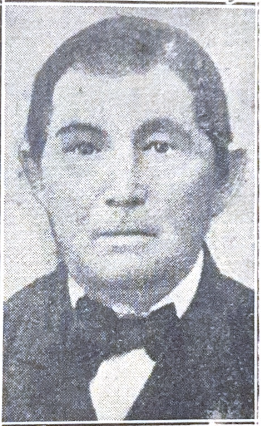
CHRISTIAN GUEBERT (I)
(Dec. 15, 1825-1892)
CHAPTER VII.
HENRY GUEBERT (I)
As already stated, Henry (I), the third of the pioneer brothers first worked for a Mr. Anton Busse. Later he was employed by Jim Ralls who resided on what is still called Ralls' Ridge, just east of Red Bud. Adjoining the Ralls farm to the south was the Foster farm, containing 200 acres. It was this place that Henry bought in 1858, and which subsequently became his home for so many years. Naturally he could not save enough in 8 years to buy a farm, and there was danger for a time that he would have to give up the place again as his creditors wished to foreclose on him. In this emergency his future father-in-law came to his assistance by lending him enough money to pay off the mortgage. From that time on his home was secure. At first Henry (I) batched, but a little later his widowed mother came and kept house for him. This arrangement continued until his marriage to Elizabeth Wicklein in 1860.
Henry (I) built a large barn 50x50 in 1866 and a new home, costing $1,800.00, in 1868. This home is still standing. All the building material that had to be bought, was hauled from Belleville, Ill., a distance of over 25 miles. Here was the nearest railroad at that time. Oats which also had to be hauled from Belleville sold for as low as 17c after the Civil War.
In spite of the hardships of the early years and a heavy debt to begin with, Henry (I) prospered. In his letter (p. 10) his brother, William (I), tells us that also Henry was well off in 1881. This is evident also from the fact that he could put up house and barn within ten years after purchasing the farm, and that he later on bought three more farms and equipped them with buildings. He had full control of all these farms until his death on July 8, 1910.
The horse-power threshing-machine accident in which he lost his leg occurred in 1875, when he was in the prime of life, just 42 years old. The little boy, who was killed in another threshing machine accident a year later (1876), was named after his father. Little Henry was seven years old at the time. He had just received a piece of butter-bread from his mother and had been permitted to go out to the machine. Arriving there he clambered up onto the separator, and, perhaps due to some faulty construction of the flooring, he inadvertently fell into the cylinder, still clutching that piece of bread in his hand. Little did his mother realize when she sent her boy out that he would be carried back into the house a lifeless form hardly five minutes later. Little Henry is the only one among the
Gueberts who has come to a violent death. Henry's (I) wife died already on June 15, 1880. She lies buried in the Horse Prairie cemetery. Thus the marital union lasted only 20 years and Henry (I) was destined to live another 30 years without his beloved helpmate. Truly the hand of the Lord was heavy upon him, as William (I) says in his letter.
Henry (I) was at first a member of the Lutheran Church in Horse Prairie and contributed generously toward the building of the present brick church in 1868. Due to some difficulty he left the Lutheran church in 1886 and later contributed to St. Peters' Evangelical Church in Red Bud. Henry lived to be 77 years old, and thus reached a more advanced age than either of the other brothers. His grave is to be found in the Evangelical Cemetery just west of Red Bud.
Henry (I) and Elizabeth Guebert had the following children:
Mary, 1860-1912
John, May 29, 1862-May 22, 1899
Elizabeth, 1864-1918
Sophie, 1880-1892
Christian, Jan. 3, 1867-
Henry 1870-1877
August, Jan. 8, 1872-
Herman, Nov. 10, 1875-
John married Mary Sathoff (born Oct. 5, 1866) in 1886, and took over the home place. Here he lived until his early death at the age of 36. He died of blood-poisoning from an infected arm. His widow is still living, spending the evening of her very busy life with her son, Henry J., on the old home place. The union of John and Mary Guebert was blessed with five sons:
Henry J., June 4, 1887-
William, June 4, 1889-
Emil, Feb. 25, 1892-
Andrew, Aug. 19, 1885-Oct. 15, 1918.
Arthur, Nov. 3, 1898-Dec. 31, 1901.
Henry J. married Lena Miller (born June 29, 1897) in 1916, and, as before stated lives on the farm of his father and grandfather. Henry has installed electric lights and other improvements, so that his farm is now one of the most up-to-date in the county. There are two children, Leona (Nov. 3, 1916), now the wife of F. F. Buch, and Irene (Dec. 4, 1918), still at home.
During the war, Henry J. was drafted into the army but was later on exempted due to the fact that he was a married man with a family. Incidentally, there were six Gueberts who were called to the colors during the great war, but only Albert R., son of August Guebert of Percy, Ill., actually saw service in France.
William, second son of John and Mary Guebert, married Emma Salger (born July 8, 1892), in 1916, and now lives on
the old Bremer farm directly north of the home place, also on the ridge. This farm was bought by his mother in 1909. William and Emma have one son, Alfred (Aug. 15, 1920).
Emil Guebert spent some time during the war in camps at Battle Creek, Mich., and Jacksonville, Fla. He married Mary Miller (born March 2, 1899), in 1935, and now lives in his own home in Red Bud. There are no children.
Andrew Guebert was also drafted to the colors and served in a camp at Louisville, Kentucky. He had been at home on furlough with his mother for 8 days. On his return trip he contracted influenza and died three days later. His body was brought to Red Bud and interred in the Horse Prairie cemetery.
Mary Guebert, eldest daughter of Henry (I), first married Fred Stellhorn, brother of Hy. and Conrad Stellhorn, of Horse Prairie, in 1883. After her husband's death in 1893, she became the wife of Aug. Ruehmkorf in 1895. Her sister, Elizabeth, was the wife of Ed. Wicklein, whom she married in 1886. She died in 1918, her husband in 1935.
Christian A. Guebert, second son of Henry (I), moved to Percy, Ill., on June 27, 1892. His father had bought him a farm, containing 229 acres, the year before. During the first three years his sister kept house for him. The barn was built in 1893, and the house in 1898.
On Dec. 12, 1895, Christian married Emilie Riechenberg (born Oct. 2, 1869). She died on Oct. 13, 1896, soon after the birth of their first child, Henry L. (born Oct. 10, 1896). A year later, Nov. 7, 1897, Christian married Caroline Rieckenberg (born Feb. 25, 1872), who bore him three girls: Clara (Aug. 20, 1898), Mary (Jan. 8, 1901), and Anna (Dec. 26, 1903).
Henry L. also served his country during the World War. He was at Camp Custer, Battle Creek, Mich., from Sept., 1918, until Feb., 1919. Henry L. married Bertha Knop (born Jan. 29, 1899), on May 8, 1921, and they have two children, Harold (Apr. 28, 1926) and Mildred June (June 1, 1932). The family reside with the parents on the home place.
Clara, eldest daughter of Christian A., is the wife of Louis Brandt, married Oct. 15, 1934. The couple live on a farm near Campbell Hill, Ill. Mary is still at home. Anna, the youngest, died on December 5, 1917.
August W. Guebert, fourth son of Henry (I), was married and moved to a farm near Percy, Ill., in 1894. His wife was the former Amanda Rathert (born July 13, 1870). She died on April 21, 1928, having been in poor health due to heart trouble for a long time.
The farm mentioned was bought by Henry (I) from a Mr. D. Schule, who was his brother-in-law. This no doubt explains how it came that these Gueberts located at Percy, Ill. August W. and his brother Christian A., are the only ones who left Red Bud to take up farming elsewhere. August's farm includes 200 acres and he still resides on this place.
August W. and Amanda Guebert had the following children:
Henry, Jan. 1, 1895-Mar. 8, 1895
Albert R., Jan. 11, 1896-
Edward H., March 17, 1898-
August, Jr., Oct. 24, 1908-
Elizabeth, Jan. 30, 1900-
Fritz, Jan. 22, 1902-
Paul, Aug. 31, 1904-
John, Jan. 5, 1906-
Albert R., as already stated, was the only Guebert to serve in the army overseas. He spent two years in the service. Albert married Adele Hartman (born Dec. 18, 1897) and they have three children: Norma (Feb. 8, 1922), Albert, Jr. (Feb. 3, 1926), and Ralph (Aug. 7, 1934). Albert R. has a share in the Blair coal mine and has bought a home in Percy, Ill.
Edward H., third son of August W., married Minnie Fastenau (born March 5, 1911), and they have one boy, Delmar Lee (Dec. 3, 1934). They live on their farm (100 acres) near Percy, Ill.
Elizabeth, only daughter of August W., is the wife of Henry J. Brandt. They have one daughter, Amanda Lucille (July 7, 1925), and live with the home folks. Elizabeth keeps house for the family while her husband is employed at the shoe factory in Steeleville, Ill.
Fritz and John, fourth and sixth sons respectively, are farming the home place. They are unmarried. Paul, fifth son, is married to Elise Miens, and they have one boy, Paul Dean (June 3, 1934). Paul is employed at the shoe factory in Steeleville and lives on his farm near Bremen, Ill. August Jr., is still single. He boards at home and is also working in the shoe factory in Steeleville.
Herman Guebert, youngest son of Henry (I), married Augusta Sommer (born Dec. 2, 1881), on November 8, 1900, and now resides on a farm due east of the home place. Whereas the home place is on the hill, Herman's place is below the hill. It is about one mile west of the Kaskaskia River and the address is Red Bud, Ill., R. F. D. No. 1.
Herman and Augusta have the following children:
Fred, Feb. 9, 1902-
Lena, June 20, 1903-
Henry, Feb. 23, 1905-
Elizabeth, Nov. 25, 1906-
Albert, Sept. 16, 1921-
Anna, Dec. 31, 1909-
Emma, Oct. 15, 1912-
Emilie, June 26, 1916-
Louis, Aug. 7, 1918-
In one respect this family is like that of Henry W. Guebert. It is a large family and all the children are living. Fred, Emma, Emilie, Louis, and Albert are still at home. Lena is the wife of Ermin Lucht (born Aug. 22, 1900), whom she married on April 2, 1922. The Luchts have two children, Luella (March 31, 1924), and Vernon (Sept. 14, 1931).
Elizabeth married Paul Hartman (born Dec. 25, 1904), on March 4, 1928. There are five children: Oliver (March 12, 1929), Gilbert (Oct. 30, 1931), Paul Jr., (Jan 31, 1933), Leroy (Jan. 6, 1935), and Freeman (June 9, 1936). Anna is now Mrs. Otto Gegel, married June 12, 1934. Their first son, Kenneth, was born Sept. 25, 1936, and has the distinction of being the youngest member mentioned in this biography. Mr. Gegel's birthday is Sept. 30, 1906. Henry's wife is the former Edna Engelhardt of Baldwin, whom he married on June 8, 1929. There are no children. The couple resides in Baldwin.
Henry Guebert (I) and Elizabeth
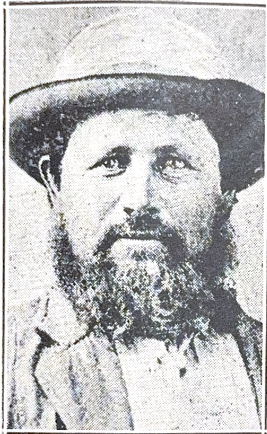
HENRY GUEBERT (I)
(August 22, 1833-July 8, 1910)
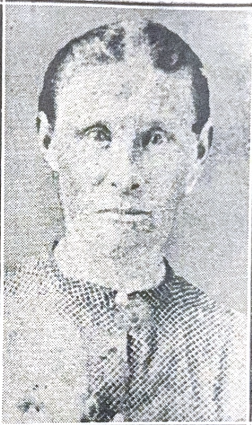
ELIZABETH GUEBERT
(Wife of Henry Guebert I)
CHAPTER VIII.
A FEW STATISTICS
Believing they will be generally interesting, we have compiled a few statistics on the basis of the tables appearing on the foregoing pages. The total number of all those who have borne the name Guebert is 225. This includes the 49 women who have received the name by marriage. 176 of these are still living, 95 of them in or around Red Bud, Ill. Of the 49 who have passed away, 16 died as children, and of these only four were infants. 91 have reached maturity, and of these four died unmarried. 69 have entered matrimony, four having married twice. We almost said there were no bachelors among the Gueberts, but Herbert, who is 38, will now qualify, and Fred, Fritz, and Lorenz will soon be eligible. Girls over 30 and not married total 5.
The descendants of William (I) number 41 boys and 36 girls, of whom 32 and 30 are still living. Children and children's children of Christian (I) (we are only counting the Gueberts) total 25 boys and 27 girls, of whom 21 and 22 are still living. Henry's (I) offspring number 28 boys and 16 girls, living, 23 and 12.
The writer and his sister and brothers are the only ones of the third generation who have lost both father and mother. No Guebert of the fifth generation has as yet appeared, though little Irene Buch, granddaughter of Henry J., and Marilyn Evers, granddaughter of the Rev. and Mrs. T. Lang, can lay claim to being fifth in line. A few more years and a full century will have passed since our fathers first placed their foot upon American soil.
CONCLUSION
We cannot close this account without calling attention to the fact that God has blessed our family most abundantly. Chief of these blessings is that we have learned to know our Savior from little on and have had the ministrations of faithful, God-fearing pastors at all times. Yea, most of us have also enjoyed the privilege of attending a Christian school, and a goodly number of the children are still enjoying this privilege. Some of us have also been accounted worthy to serve the Lord in His vineyard. With but few exceptions all have remained faithful to their confirmation vow and are still members of the church.
Also in a material way there has been no lack of God's blessing. Though none have become extremely rich, yet a goodly number own their own homes and all have been enabled to earn an honest living. Even in these hard times, none have been on relief. So far as we know, no one has been afflicted with a malignant disease. No one is crippled or deformed. Since 1876 there has been no major accident. No one has ever been convicted of a serious crime or served even a minor jail sentence.
We mention all this not in a spirit of boasting, but in order to show that our family has been blessed above many others and that we have every reason to be sincerely thankful to our kind heavenly Father. Let us be ever mindful of His benefits, seek to remain His children, and lead a life of service to Him. Then the time will finally come when we shall join another and greater family, namely the family of God's elect in Heaven, and hold happy reunion with all those whom He has already taken unto Himself.
His grace always endureth,
And children's children yet shall prove
How God with strength assureth
The hearts of all that seek His love.
ADDITIONAL ITEMS
(Births, Deaths, Marriages, etc.)
[Space for additional family records and updates]
The deed is unique in more respects than one. In the first place it is written entirely in long hand. Even the seal, if we may call it that, is hand drawn. The certification by the Justice of the Peace was evidently written by him for the handwriting is different from the foregoing. The spelling of the words, which we have retained throughout, is also worth noting. The names of the buyers in the original draft always appeared as "Frederick Christian and William Frederick Gubert". Evidently the Justice of the Peace opined that the name Guebert should be inserted also after the name "Christian". At any rate our good Mr. Simpson, J. P., wrote the name between the lines at four different places. We have attempted to show this by placing these in brackets ( ). The reader will note that he spelled the name differently almost every time. Also the name Simmons appears sometimes with and sometimes without the s. It will also be noted that the Mc is missing after the word Mary in the signature. Yet the Mc is quite plain in other instances. Mrs. McSimmons evidently could not write and therefore made only an X. Even this cross looks as though it might have been the only one she ever made in her life.
What is of still greater interest is the fact that the amount of "Forty Hundred Dollars" was paid at the time of the transaction. The deed plainly shows that the original price was fifty hundred and the word forty written over it. Most likely Mr. McSimmons reduced the price to $4,000.00 ($16.66 per acre) because he was being paid in cash; but a rather puzzling question is where the two brothers got the $4,000.00. That Of course, it is possible that the family sold their holdings in Germany and that Christian brought along at least some of the money from the old country. In spite of the evident imperfections in the document it must have been good for no one ever challenged its validity.
On the back of the deed we find these notations:
We have in our possession another deed recording the sale of forty acres of land described thus: the South Half of the West half of the N. E. Quarter of section No. 19, in Township 4, South of Range 8 West. This is the parcel of land lying in the bottom behind Blackjack, south of Red Bud, owned by Henry W. Guebert. It was sold to Mr. Mc Simmons in 1839 for the grand sum of fifty dollars ($50.00) by one James H. Patterson and his wife Elizabeth. Thus Mc Simmons paid exactly $1.25 an acre for this land. But there is a reason for that. Students of history will remember that a financial panic and extremely hard times followed the "wildcat" banking and speculation during President Andrew Jackson's administration (1829-1837). This no doubt accounts for the ridiculously low price paid for Illinois land, 17 years after Illinois had become a state.